

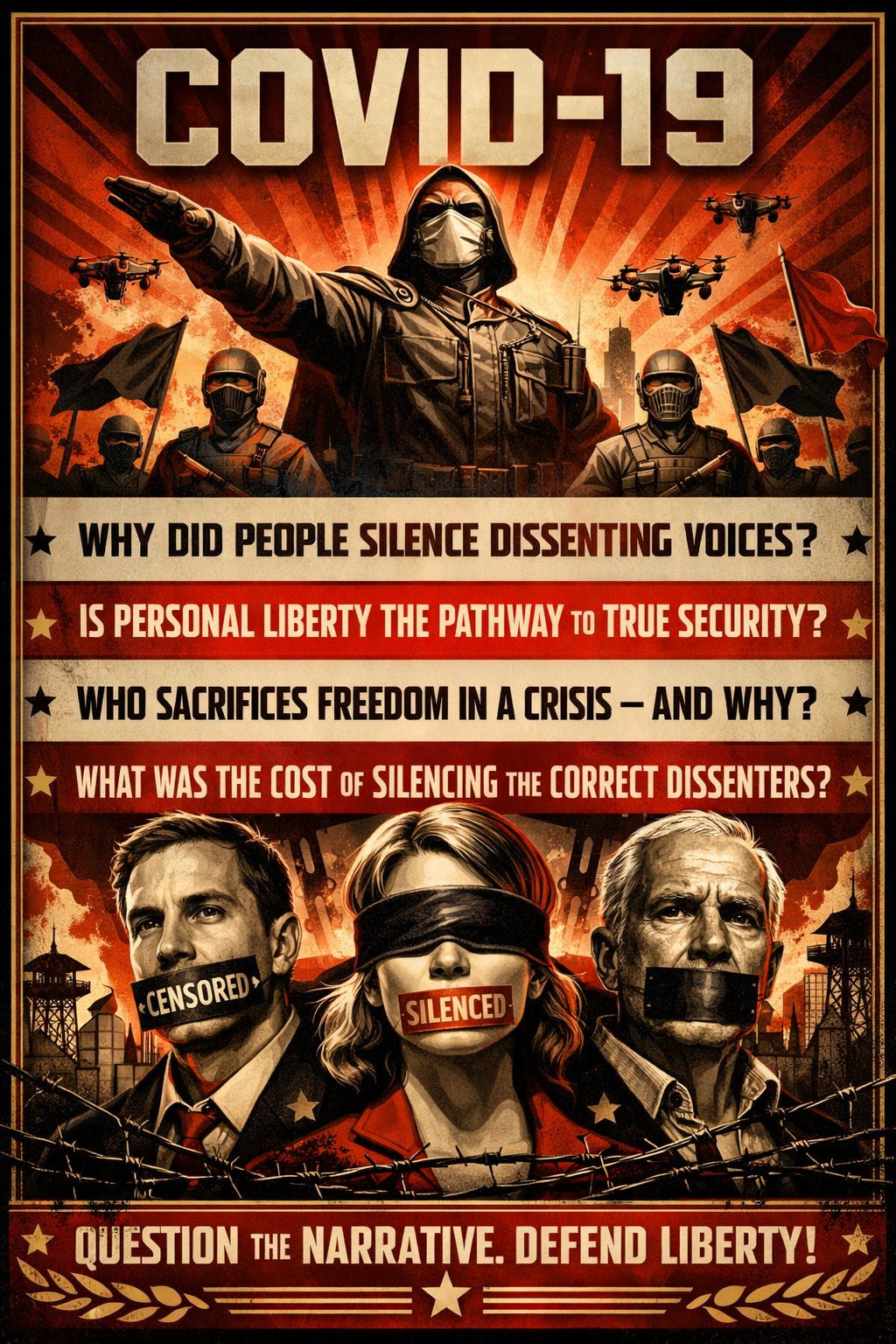
Why Does Society Silence Correct Dissenters When They Sacrifice Personal Liberties for the Illusion of Security?
Historians and sociologists who ask tough questions have not tackled this one.

In addition to the question in the title, there are corollary questions worth considering:
What psychosocial mechanism explains why people silenced voices that threatened the prevailing narrative of safety?
Why is the protection of personal liberties the only pathway to durable security in an open society?
Who is most eager to offer up (and demand others offer up) personal liberties in a crisis, and why?
What were the real costs of silencing the correct dissenters?
In the spring of 2021, a slender report issued by the Center for Countering Digital Hate slipped into the quiet machinery of Washington and Silicon Valley. Titled “The Disinformation Dozen,” it identified twelve figures—Joseph Mercola, Robert F. Kennedy Jr., Christiane Northrup, and eight others—whose online commentary, the authors calculated, had seeded nearly two-thirds of the vaccine-skeptical content then eddying across Facebook and Twitter.¹ The accusation carried the gravity of indictment: these were not merely errant voices but vectors of harm, agents of peril in a season of genuine mortality. The platforms, already attuned to the public mood as a form of policy, responded with practiced efficiency. Accounts were de-boosted, videos demonetized, posts draped in cautionary overlays or allowed to vanish into the ether.
The White House, too, entered the lists. President Biden, in a phrase that would echo through subsequent congressional inquiries, suggested that Facebook itself was “killing people” by countenancing such material.² What went largely unremarked at the time was that many of the dissenters’ earliest reservations—concerning the hidden costs of prolonged lockdowns, the plausible laboratory origins of the virus, the first epidemiological intimations of vaccine side effects—would, in the years that followed, drift from the disreputable fringe toward the subdued center of allowable discourse. We heretics, if not infallible, had been directionally prescient. And the society that punished them had done so, in some essential way, because of that prescience: their warnings threatened the comforting illusion that sacrifice had purchased safety.
The Fear of Lost Hope
This was never a simple chronicle of miscalculation or institutional excess. It was, rather, a study in comfort: a collective emotional compact forged in crisis and defended, with an almost reflexive tenacity, against any intrusion that might unsettle it. Between 2020 and 2025, a delicate psychological mechanism took hold across much of the developed world. One might call it the fear of lost hope—the dread not of actual danger but of losing the feeling of security once that feeling had been secured through the barter of liberties. Having traded certain personal liberties—speech, inquiry, the quiet prerogative of bodily dissent—for a felt sense of collective safety, people found themselves curiously invested in the transaction. Warnings that those liberties might constitute the very architecture of enduring security registered not as prudent counsel but as a species of theft: a subtraction from the consoling story that sacrifice had purchased safety. The dissenters became hope thieves, and society moved to silence them.
The rhetorical scaffolding of such silencing was hardly novel. History supplies antecedents phrased with a chilling reasonableness. In Berlin on December 10, 1940, addressing an assembly of workers, Adolf Hitler remarked, “Yes, certainly, we jeopardize the liberty to profiteer at the expense of the community, and, if necessary, we even abolish it.”³ Two years earlier, on May Day 1939, in the Lustgarten, he had articulated the principle with still greater elegance: “The liberty of the individual ends where it starts to harm the interests of the collective. In this case the liberty of the Volk takes precedence over the liberty of the individual.”⁴ And, by way of summation, “Above the liberty of the individual, however, there stands the liberty of our Volk.” Benito Mussolini, in the 1932 Doctrine of Fascism, struck a softer, almost administrative note: the state “has curtailed useless or possibly harmful freedom while preserving those which are essential. In this field the individual is not deprived of his liberty, but he is given a clearer and more definite liberty than that of the old Liberal State.”⁵
These formulations do not declaim; they tidy. They speak the measured language of prudent husbandry—pruning only the harmful, the selfish, the perilous—so that the garden of the collective might flourish. These statements are the precise forebears of the public-health rhetoric that prevailed through the pandemic years: we are not curtailing speech out of tyranny, but out of solicitude; not abolishing liberty, merely rendering it more responsible.
But what if the perilous are correct? Deference to the illogic of a claimed monopoly on knowledge makes totalitarianists powerful.
The psychology that made such language persuasive is less doctrinal than neurological. Human beings did not evolve to inhabit prolonged uncertainty with equanimity. Our Pleistocene inheritance favors swift consensus under threat: the tribe draws close, the shaman speaks, the danger recedes, and the reward arrives as a flood of dopamine and oxytocin that feels, quite simply, like safety—the hope-drug. In the contemporary iteration, the state and its expert caste assumed the shaman’s mantle. Others outside the tribe are not afforded the special dispensations we afforded our relatives and tribespeope. Once the narrative—“We have sacrificed a little freedom and now we are protected”—settled into place, it dispensed a potent emotional narcotic. Any suggestion that the sacrifice had been imperfectly calibrated, or that individual liberties might serve as the indispensable error-correcting sensors of a complex society, activated the anterior cingulate cortex’s quiet alarm: not at the facts in dispute, but at the emotional cost of revising the story. The dissenter became, in effect, a hope thief.
Silencing ensued as reflex rather than plot. The group perceived the liberty-warner as a vector of emotional contagion, a carrier of doubt capable of unraveling the communal comfort. Ridicule, de-platforming, the gentle arithmetic of moral reproach—“You are undermining the common good”—worked to restore homeostasis. Studies show that roughly a quarter to a third of any population registers high on traits such as need for cognitive closure and dutifulness;⁶ in crisis, these individuals emerge as the early adopters and most vigilant custodians of the new dispensation. Their nervous systems register ambiguity as distress and sacrifice as quiet virtue. The remainder conforms through the immemorial mechanics of social proof. The asymmetry is instructive: most prefer that others relinquish liberties first, yet applaud when the willing few render the trade respectable. The ratchet turns. Emergency measure hardens into custom, because the restoration of the old liberties would demand precisely the deliberative calm that crisis has already eroded.
The mechanism found its clearest expression in the campaign against the Disinformation Dozen. The Center’s 2021 report portrayed the twelve not as concerned, informed citizens ahead of the pack but as superspreaders of harm. Facebook applied algorithmic throttling and fact-check overlays. Twitter, still under its former stewardship, employed shadow-bans and account restrictions. YouTube demonetized videos that ventured outside the sanctioned orthodoxies on lockdowns, natural immunity, or vaccine durability. Subsequent disclosures illuminated the choreography. In 2024, Mark Zuckerberg wrote to Representative Jim Jordan conceding that senior Biden-administration officials had “repeatedly pressured” Meta for months to censor COVID-related content, even when it included humor and satire.⁷ By 2025, Google informed the House Judiciary Committee that the administration had urged YouTube to suppress material that did not violate its own policies; the company pledged a process of reinstatement.⁸ The Twitter Files, released in late 2022, had already mapped the quiet collaboration between federal agencies and the platforms. What had been presented as voluntary corporate stewardship revealed itself, in hindsight, as a tacit partnership to sustain the prevailing narrative of safety.
The dissenters’ true offense was tonal. They punctured the narcotic. When early voices raised questions about excess non-COVID mortality, fertility signals, or the durability of vaccine-induced immunity, they compelled a reckoning with the possibility that the collective bargain had been imperfectly drawn. The response was excision. The platforms became the enforcement arm of the false-security narrative; silencing restored the emotional equilibrium.
The irony is now unmistakable. By disabling the decentralized mechanisms of error-correction—independent inquiry, the unruly marketplace of ideas—society rendered the system more brittle. Groupthink flourished. Early signals were overlooked or dismissed. Trust in institutions, already attenuated, frayed further. All the easier for myths and lies on vaccine efficacy to perpetuate. By 2025, even the platforms were quietly retreating. YouTube began restoring accounts. Meta experimented with community notes. The narcotic had faded, yet the guardrails that might have tempered the overreach had been quietly dismantled.
The episode was not anomalous; it was exemplary. Crises lay bare an ancient truth our evolutionary inheritance never quite forgot: we are wired for contextual individualism. We barter liberties when the environment cries existential threat, because for most of our history that barter was the only viable strategy. The dutiful, the certainty-seeking—those for whom autonomy feels loneliest in the storm—are not villains; they are the accelerants of the bargain. The rest of us accede because standing apart feels, at the cellular level, like evolutionary suicide.
Recognizing the deficiency of this outmode survival loop does not excuse it.
The corrective resides within the same species. There have always been those wired for reactance and openness, who feel the erosion of liberty more acutely than the temporary warmth of the cage. They are neither heroes nor cranks; they are the redundant sensors the system requires. Forevermore, everyone should fact-check the fact-checkers. It’s healthy. It should be welcome. The comfort zone of your every day is yours to defend. Do not leave it to others. Take the time to really understand the real threats.
The years 2020 to 2025 demonstrated, with clinical clarity, that individual liberties are not ornamental. They are the architecture of durable security. When we silence the correct dissenters to preserve the feeling of safety, we guarantee the very insecurity we dread. The comfort was illusory. The warnings were not. Awareness of the mechanism may be the slender advantage we carry into the next crisis: the knowledge that, sometimes, the kindest act a society can perform is to listen to the voices that make it uneasy.
Join us to continue the discussion as we stay viligant. Live studio audience webinars, every two weeks.

References
¹ Center for Countering Digital Hate, “The Disinformation Dozen,” March 24, 2021.
² President Biden, July 16, 2021.
³ Adolf Hitler, speech at Rheinmetall-Borsig Works, Berlin, December 10, 1940.
⁴ Adolf Hitler, speech in the Lustgarten, Berlin, May 1, 1939.
⁵ Benito Mussolini (with Giovanni Gentile), The Doctrine of Fascism (1932).
⁶ D. M. Webster & A. W. Kruglanski, “Individual Differences in Need for Cognitive Closure,” Journal of Personality and Social Psychology (1994).
⁷ Mark Zuckerberg, letter to Rep. Jim Jordan, August 26, 2024.
⁸ Alphabet/Google, letter to House Judiciary Committee, September 23, 2025.
What a well written terrific article. Those of us already well aware of vaccine dangers due to raising someone with autism, didn't have to think twice about Covid vax dangers. The groupchats are very good.Everyone should join.
This article rings true. It makes me recall the experiments of Stanley Milgram, which have been repeated around the world in many cultures. Depending on the conditions, roughly 80% of people followed what they believed were demands by an authority, even in some experimental conditions to the point they believed they would kill someone.
Looking at revolutions or covid shots, there were some early who called for change and, having done so, others heard their call. As I recall some 22% of the public in one article were against the jab early on. In some ways amusing, those calling for putting people in camps, not getting medical care without covid vaccination and so on try to pretend they didn't go there. My friend told me at work in a meeting she told a coworker, who denied it, that she called for putting her in a reeducation camp. My friend said, "I still have your email." A historically based movie, The Labyrinth, shows this denial is typical human nature for those involved in shutting others down.
Because of this behavior of the majority, psychological manipulation has been honed to a fine point and used not only by advertising, but governments. This is depressingly documented in “Covid-19,” Psychological Operations, and the War for Technocracy by David Hume.
In 1543 Copernicus published his work that the earth revolves around the sun, largely accepted by the scientific community, but the Catholic Church didn't lift their ban on these books until the 1800's though others had come to accept the idea earlier. This is one example of how power fights to maintain control, for change would require reassessing their belief or intellectual foundations and admitting to being incorrect.
So, while truth eventually outs, when truth tellers' reputations and lives may be repaired by it, the depressing fact is that roughly 80% will follow authority, that authority will lie and fight to keep control, and free thinkers and truth tellers will be attacked.
What this means is most people who have come over to the other side on things like the jab will once again be against truth tellers for new situations. That means a person in that 20% who sees things differently based on facts or morality should remember Sun Tsu: “If you know the enemy and know yourself, you need not fear the result of a hundred battles. If you know yourself but not the enemy, for every victory gained you will also suffer a defeat. If you know neither the enemy nor yourself, you will succumb in every battle.”