


David M. Morens, a former senior adviser in the Office of the Director of the National Institute of Allergy and Infectious Diseases, pleaded guilty on August 18, 2026, in the U.S. District Court for the District of Maryland to Count One: conspiracy to commit offenses against and to defraud the United States, in violation of 18 U.S.C. § 371. The signed plea agreement is unusually informative: it says the conspiracy contemplated violations of 18 U.S.C. § 1519 (destruction, alteration, or falsification of records in a federal matter), 18 U.S.C. § 2071(a) (concealment, removal, mutilation, or destruction of federal records), and 18 U.S.C. § 201(c) (illegal gratuities). Morens admitted guilt to the § 371 conspiracy; the government agreed that the remaining open counts would be dismissed at sentencing. [1]
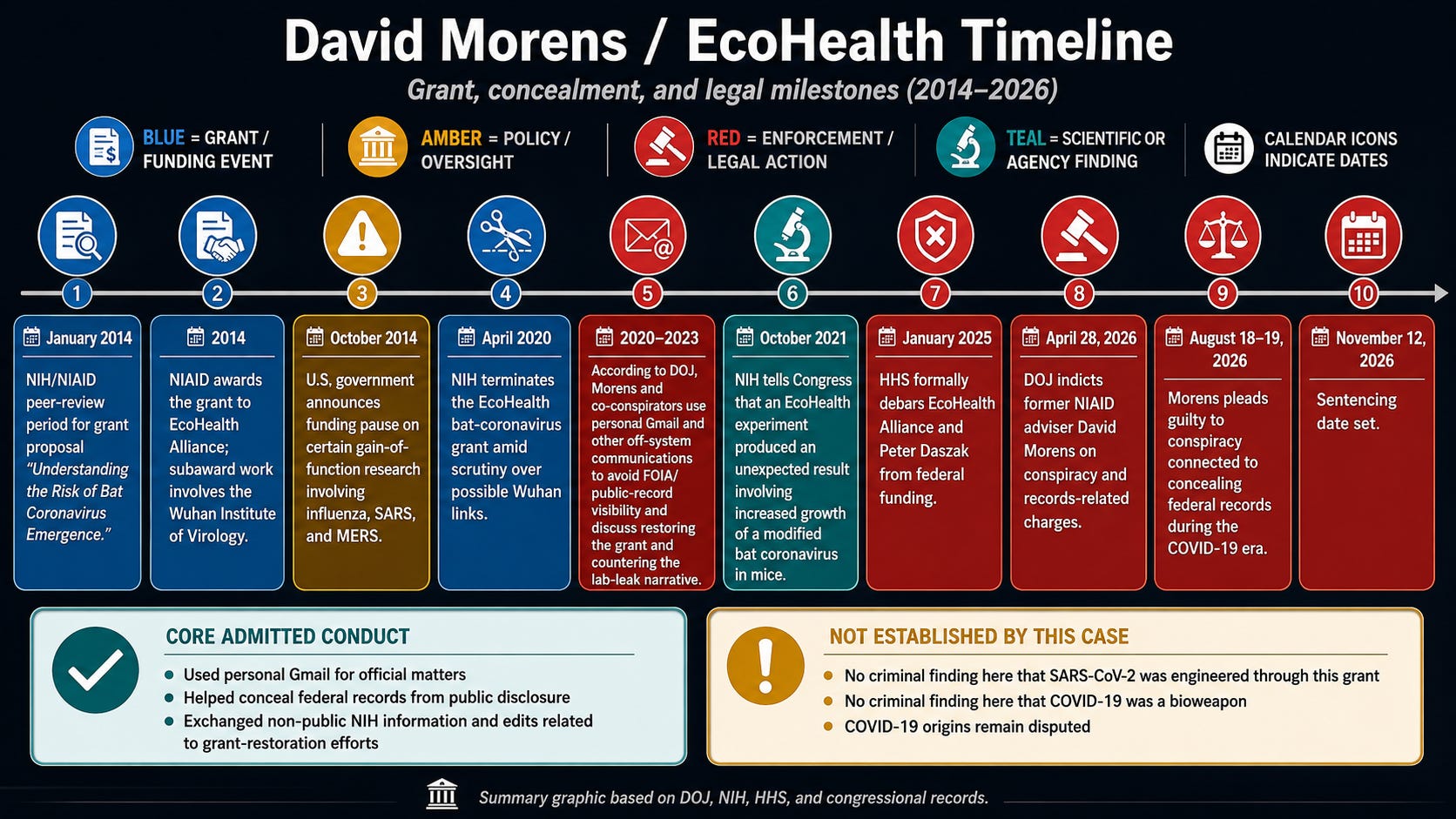
According to DOJ, after NIH terminated the grant Understanding the Risk of Bat Coronavirus Emergence, Morens and others anticipated Freedom of Information Act requests and agreed in writing to shift communications concerning the grant, NIH funding, and COVID-19 origins to Morens’s personal Gmail account rather than his official NIH account. DOJ says those communications included nonpublic NIH information, edits to letters intended for NIH leadership, efforts to restore funding to the grant recipient, and information “back-channeled” to a senior NIAID official. Morens also admitted that the conspiracy involved illegal gratuities: a co-conspirator sent him wine after his “behind-the-scenes shenanigans,” and further high-end meals were discussed. [2]
The criminal case establishes intentional misconduct concerning federal records, government processes, and gratuities—not the origin of the virus. Prosecutors have not accused Anthony Fauci of wrongdoing in Morens’s case. [3]
The connection to the underlying grant is nevertheless real rather than speculative. HHS records identify NIAID award R01AI110964, “Understanding the Risk of Bat Coronavirus Emergence,” as an EcoHealth Alliance award beginning June 1, 2014; the original FY2014 award action was $666,442. DOJ expressly says the grant recipient made a subaward to the Wuhan Institute of Virology. Public records and major-news reporting make EcoHealth Alliance and its then-president Peter Daszak the overwhelmingly likely identities of “Company 1” and “Co-Conspirator 1,” although DOJ deliberately leaves them unnamed in the plea documents. The Washington Post reports that previously released records likewise point to Boston University scientist Gerald Keusch as “Co-Conspirator 2.” Neither Daszak nor Keusch was reported charged in this case as of August 19. [4]
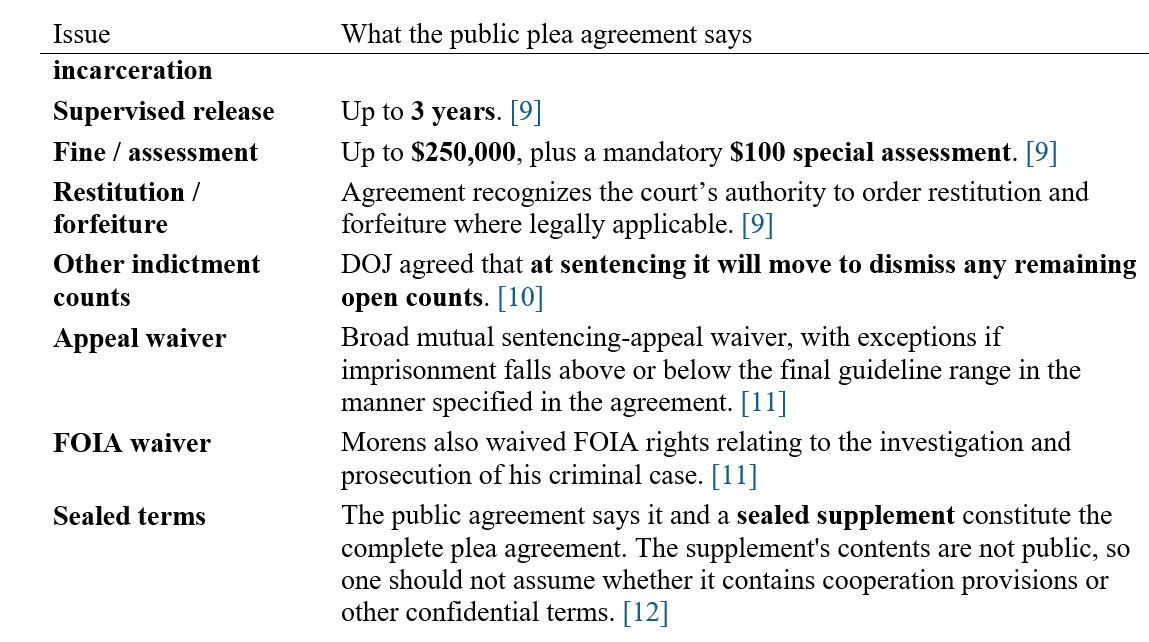
On sentencing, there is an important correction to some commentary: there is no publicly agreed or recommended prison term in the plea agreement. The statutory range is zero to five years’ imprisonment, up to three years of supervised release, a maximum $250,000 fine, and a $100 special assessment. The parties stipulated to guideline calculations that, after the anticipated three-level acceptance-of-responsibility reduction, produce offense level 15, with Morens permitted to argue for another two-level reduction under the “zero-point offender” provision. If that reduction applies, the level would be 13. Both sides expressly reserved the right to advocate for a reasonable sentence under 18 U.S.C. § 3553(a). Sentencing is scheduled for November 12, 2026, before U.S. District Judge Paula Xinis. [5]
Morens’s plea materially strengthens the proposition that an NIAID senior adviser intentionally circumvented federal recordkeeping and public-access mechanisms while helping people with a direct interest in the controversial coronavirus grant. As presented, the case does not strengthen the virological evidence that the pandemic began in a laboratory nearly as much as it strengthens the evidence of a transparency and government-integrity failure.
The criminal case, plea terms, and sentencing exposure
Morens served as a senior adviser in NIAID’s Office of the Director from 2006 through 2022. DOJ says his work included advising senior NIAID personnel, developing policy recommendations, gathering information from grantees and scientists, and briefing a person designated “Senior NIAID Official 1” about COVID-19 and prior NIAID coronavirus research. [6]
The federal case is United States v. David M. Morens, No. 8:26-cr-00138-PX (D. Md.). Public docket information indicates the case/indictment was filed April 16, 2026; DOJ publicly announced the indictment on April 28. Morens was originally indicted on five counts involving conspiracy, destruction/alteration/falsification of records, concealment/removal/mutilation of records, and aiding and abetting. [7]
What Morens actually pleaded guilty to
The statutory provisions correspond closely to the conduct DOJ alleged. Section 371 criminalizes an agreement by two or more people either to commit an offense against the United States or to defraud it, coupled with an overt act. Section 1519 covers knowing destruction, alteration, concealment, or falsification of records with intent to impede or influence a federal matter; its maximum penalty is 20 years. Section 2071(a) addresses willful and unlawful concealment, removal, mutilation, obliteration, or destruction of federal records and carries up to three years. [13]
DOJ’s April release described the original five-count indictment but did not reproduce a reliable count-by-count table for Counts Two through Five. Only Count One, § 371, is the conviction, while §§ 1519, 2071(a), and 201(c) remain relevant as objects and guideline conduct. [14]
The sentencing-guideline stipulation
The public plea contains substantially more sentencing detail than the DOJ press release:
The parties agreed to a base offense level of 14 under U.S.S.G. § 2J1.2(a). They reached that guideline through the cross-reference in § 2C1.1(c)(1), because the offense facilitated another criminal offense—specifically a § 1519 offense—and the resulting § 2J1.2 offense level was greater. They then agreed to a two-level increase under § 2J1.2(b)(3)(C) because the offense was “otherwise extensive” in scope, planning, or preparation, and another two-level increase under § 3B1.3 for abuse of a position of public trust or special skill. [15]
DOJ does not oppose a two-level acceptance-of-responsibility reduction under § 3E1.1(a) and agreed, assuming continued compliance, to move for the additional one-level reduction under § 3E1.1(b). Morens preserved the right to seek a further two-level reduction under § 4C1.1 for qualifying zero-point offenders; prosecutors preserved the right to oppose it. The parties made no agreement concerning his criminal-history category. [16]
That yields the following useful—not binding—sentencing picture:
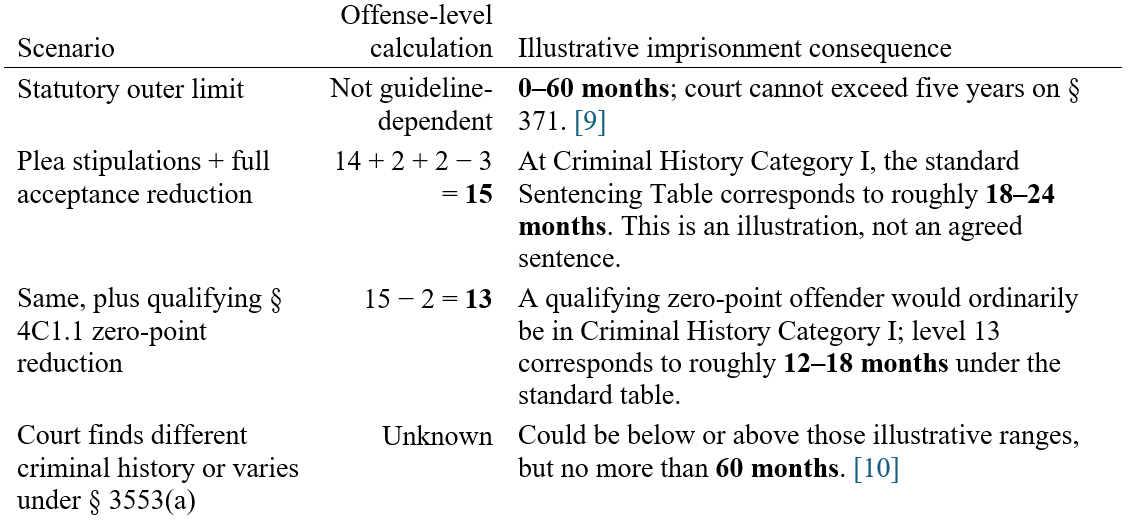
Two cautions matter. First, the court—not the plea agreement—determines the final guideline range. Second, because sentencing occurs after the annual November 1 guideline-update date, the court must apply the legally appropriate Guidelines Manual and address any ex-post-facto issue if amendments would disadvantage the defendant. Accordingly, the month ranges above are best treated as orientation, while offense levels 15 and potentially 13 are the more important plea-derived facts.
Most importantly, the public plea contains no agreed recommendation such as “12 months,” “18 months,” probation, or the statutory maximum. Paragraph 9 says both the government and Morens reserve the right to advocate for a reasonable sentence based on § 3553(a). Sentencing is set for November 12, 2026. [17]
Timeline and the people and institutions involved
The official grant record is valuable because it separates documented dates from dates circulating in commentary. HHS TAGGS lists a May 27, 2014 new-award action and a June 1, 2014 performance start for R01AI110964. NIH “reviewed” the grant in January 2014. [18]
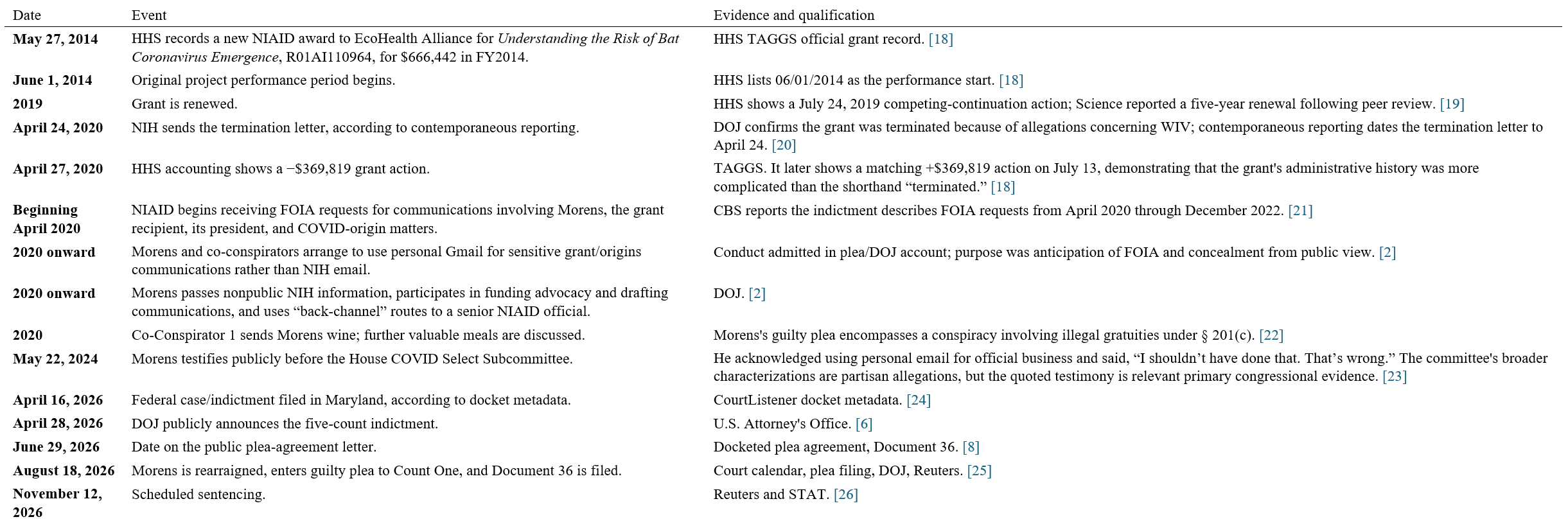
The distinction between grant/scientific participants and criminal-conspiracy participants is essential. A scientist’s collaboration on grant-supported work is not evidence that the scientist agreed to Morens’s Gmail/FOIA scheme.
Primary documents and how major outlets reported the plea
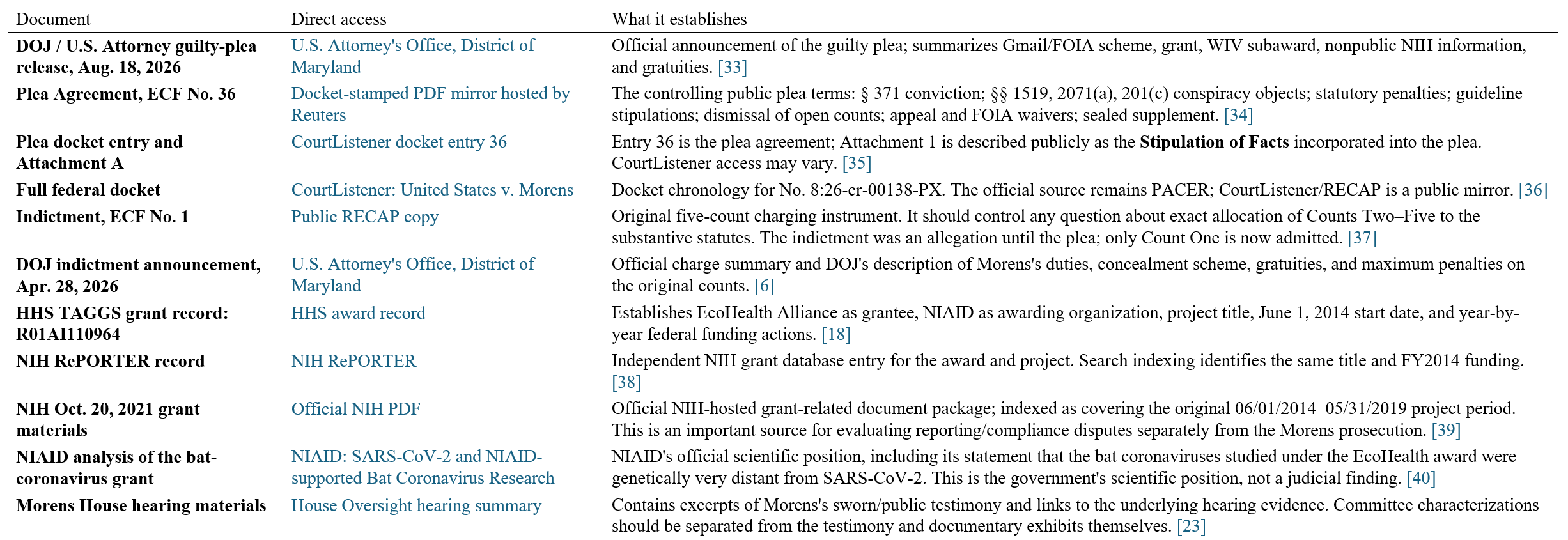
A particularly important investigative limitation is the sealed supplement to the plea. The public agreement expressly incorporates it as part of the complete deal. It would be unjustified to state that Morens has agreed to cooperate against any particular person unless the supplement is unsealed or DOJ files a subsequent cooperation-related motion. [41]
The “gain-of-function” wording requires precision
There are at least three propositions that are frequently conflated.
One is that the grant involved potentially risky experimental coronavirus research. The official award record unquestionably concerns SARS-related bat coronaviruses, human-cell entry, animal illness, spillover potential, and related virology. That is a fair characterization of the research program. [18]
A second, more technical proposition is whether every experiment at issue satisfied a particular U.S. regulatory definition such as the historically applicable framework for “gain-of-function research of concern” or enhanced potential pandemic pathogens. That is a policy-definition question, not something Morens admitted in his criminal plea. Conflating the broader scientific phrase “gain of function” with a narrower federal review category is a major source of apparent contradiction in the public debate.
A third proposition is that this research created SARS-CoV-2. That requires sequence, phylogenetic, laboratory-provenance, and chain-of-custody evidence. Nothing in the Morens plea supplies it. IPAK research supplied the sequence-based phylogenetic evidence in January of 2020 pointing squarely at sequence or virus sharing between Nanjiang Command and WIV. NIAID’s public position has been that the grant-supported bat coronaviruses were far too genetically distant from SARS-CoV-2 to constitute its direct progenitor, but IPAK found functional motifs in the HKU-series sequences that has not, even to this date, been brought into evidence. [40]
Conversely, the origin question cannot honestly be described as legally or scientifically “closed” in favor of natural spillover either. Reuters’ current summary says the U.S. intelligence community remains divided: the FBI has favored a lab-related origin; the CIA shifted in 2025 to a lab origin with low confidence; four other agencies and the National Intelligence Council have favored natural transmission. [42]
There is also significant peer-reviewed evidence favoring a market-linked zoonotic emergence. A 2024 Cell study analyzing Huanan market environmental samples found wildlife DNA—including species susceptible to SARS-CoV-2—in SARS-CoV-2-positive sampling locations and concluded that the genetic/geographic pattern was consistent with market emergence. That is strong circumstantial evidence for an animal-market pathway, but environmental co-occurrence is not equivalent to recovering the actual infected source animal before the outbreak. [52]
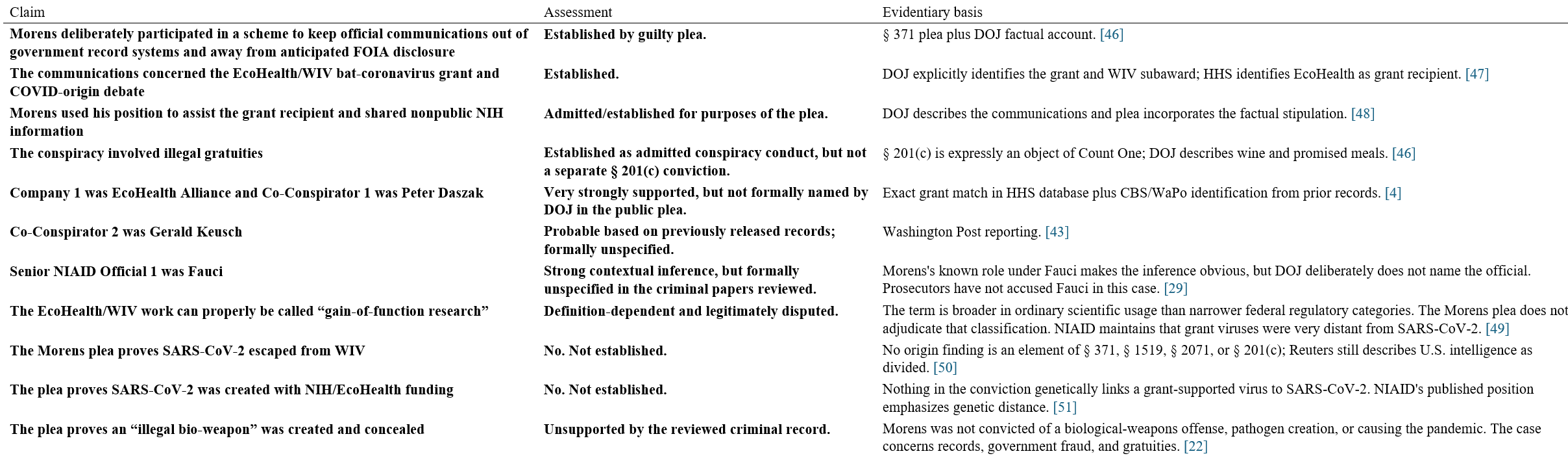
Accordingly, our credibility assessment is:
The records-concealment allegation is now extremely strong because Morens admitted it. The allegation that NIH-funded work involved controversial forms of coronavirus manipulation is serious, probable and was made definition-sensitive by “I am the Science!” Fauci, but it should be examined from the original protocols as-they-were rather than slogans. A laboratory accident remains a highly likely origin hypothesis, but Morens’s case and his plea do not prove it. The claim that the case demonstrates intentional creation or concealment of a “bio-weapon” is presently unsupported by presented evidence but would require re-examination of sequence data from the Nanjiang Command research unit (available in January 2020 in the US NCBI gene sequence databases) and the real-time laboratory records of Wuhan Institute for Virology’s records of functional passage experiment on viruses made with those and other sequence. The former was present in January 2020 by IPAK. The latter are likely long-ago destroyed or buried deep in the Chinese government’s intelligence archives.
Important unresolved factual questions
The most consequential missing evidence is not whether Morens used Gmail—he has effectively resolved that question against himself. It is what information was actually lost to the federal record, which FOIA responses were rendered incomplete, who knew about the practice, and who affirmatively joined it. DOJ has not publicly quantified how many responsive records were omitted, which particular FOIA productions would have differed had the records been preserved, or which emails remain irrecoverable. [53]
Likewise, the public plea does not establish that a senior official above Morens instructed him to use private email, authorized deletion, or knew that records were being evaded. Morens’s communications and the House investigation raise legitimate questions, but prosecutors specifically have not accused Fauci of wrongdoing in Morens’s prosecution. [43]
The grant chronology also deserves more precision than many commentaries provide. Official HHS data show a new award action on May 27, 2014, not January; April 2020 deobligation followed by a July 2020 matching re-obligation; subsequent grant actions in later years; and later modifications to the research. Thus “the grant was terminated in April 2020” is correct as an event but incomplete as a description of the award’s later administrative history. [31]
Finally, because the plea agreement incorporates a sealed supplement and a separate factual stipulation, the currently public record is incomplete. That gap matters especially to speculation that Morens is cooperating against others. Such cooperation is possible in the abstract but cannot responsibly be asserted from the sealed filing’s existence alone. [41]
Legal and policy implications
We predicted that Moren would be offered a plea deal and specific charges dropped in exchange for testimony against Fauci and others. We speculate that this still very likely.
The Morens case is unusually important because it connects routine-sounding records-management rules to criminal obstruction and public-corruption statutes.
Under the Federal Records Act, an executive-branch employee who conducts official business through a nonofficial electronic messaging account must either copy an official account when creating or sending the record or forward a complete copy to an official account within 20 days. NARA explicitly states that official business conducted through personal accounts can create federal records regardless of the platform. [54]
That means the legal problem is not simply “using Gmail.” Personal email can occasionally be used lawfully if the resulting federal record is captured as required. The much more serious allegation against Morens—and now the conduct underlying his plea—is using Gmail because communications were expected to be requested and intentionally keeping those communications away from the government record system and public view. [55]
NARA’s current guidance also says agencies must report known unauthorized destruction of federal records to the Office of the Chief Records Officer and notes that federal law provides criminal penalties for certain unlawful destruction or removal of federal records. [56]
FOIA itself should be analytically separated from the criminal statutes. FOIA, 5 U.S.C. § 552, is principally a disclosure regime. Morens’s felony exposure did not arise merely because someone might have frustrated a FOIA requester; it arose because prosecutors alleged an agreement to defraud the government and conduct falling within records-destruction/obstruction and gratuities statutes. That distinction explains why Count One cites § 371 and expressly incorporates §§ 1519, 2071(a), and 201(c). [57]
The case therefore suggests several policy failures beyond one employee’s conduct. Agencies handling politically sensitive research need systems that automatically capture senior officials’ substantive electronic communications rather than relying exclusively on users to self-forward them. NARA itself has emphasized automated capture as a means of reducing dependence on individual recordkeeping decisions. [58]
Grant oversight poses a second problem. A senior government official privately assisting a grantee in its funding dispute while exchanging nonpublic NIH information—and simultaneously accepting things of value from an interested participant—creates obvious institutional-integrity concerns regardless of one’s view of COVID’s origin. The plea’s abuse-of-public-trust enhancement underscores that dimension. [59]
A third problem is biosecurity governance. Highly consequential pathogen research benefits from a paper trail that is both scientifically reproducible and administratively auditable: original specific aims; all modifications; recombinant constructs and sequence data; biosafety risk assessments; foreign-subaward statements of work; annual progress reports; incident logs; review determinations; and correspondence explaining why particular work did or did not trigger heightened review. The EcoHealth controversy illustrates how the absence, delay, or politicization of those records makes a later origin investigation far harder.
Potential exposure of other people
A conspiracy conviction necessarily means Morens admitted an agreement involving at least one other person; it does not mean every person mentioned in his emails is a criminal co-conspirator. Nor does an uncharged co-conspirator designation constitute a conviction. [57]
The apparent identification of Co-Conspirator 1 as Daszak and Co-Conspirator 2 as Keusch therefore creates legitimate investigative questions, particularly because § 201(c) gratuities are part of the admitted conspiracy. But as of the reporting reviewed for August 18–19, neither was reported charged in this prosecution. [28]
Fauci’s position requires still greater caution. The Washington Post expressly reports that prosecutors did not accuse him of wrongdoing in Morens’s case. Biden also issued Fauci a preemptive federal pardon before leaving office, a fact that could independently complicate federal criminal exposure for conduct within its scope. A pardon is not evidence that the recipient committed an offense, and Morens’s guilt cannot be imputed to Fauci because of their professional relationship. [43]
There are nevertheless legitimate investigative avenues involving anyone who may have knowingly participated: conspiracy, obstruction, unlawful records destruction, gratuities, false statements, or other offenses can apply only if prosecutors can prove each person’s required knowledge, intent, conduct, jurisdictional facts, and timeliness independently. Association with EcoHealth, WIV, Fauci, Morens, Baric, or Shi is not a substitute for those elements.
The sealed supplement may eventually prove important. If Morens is providing substantial assistance, a later government sentencing motion could reveal that; if not, the absence of such a filing may also be informative. Until then, descriptions of him as having “flipped” on Fauci, Daszak, or anyone else are speculation, including our own.
The highest-value next steps are now documentary rather than rhetorical:
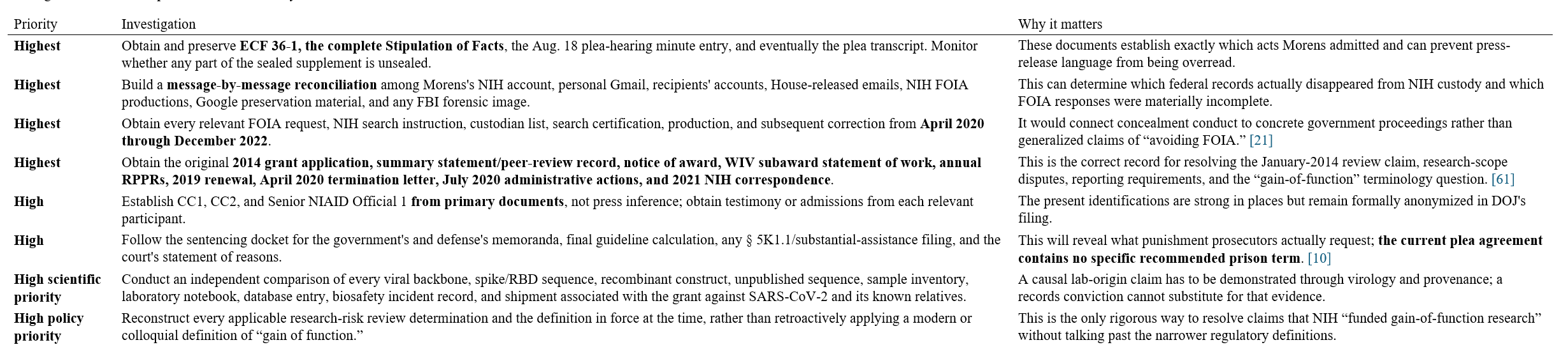
This is the only rigorous way to resolve claims that NIH “funded gain-of-function research” without talking past the narrower Fauci-imposed regulatory definitions.
The central investigative lesson is that the Morens plea should neither be minimized nor made to carry evidentiary weight it cannot bear. It is a major validation of concerns raised about federal-records integrity: a senior NIAID adviser has now admitted a felony conspiracy whose agreed objects included obstruction/records offenses and illegal gratuities, arising from communications about one of the most scrutinized research grants in modern public health. [46]
At the same time, there remains a large evidentiary distance between “officials deliberately concealed records concerning a controversial Wuhan-linked grant” and “that grant created SARS-CoV-2”, and an even greater distance to “they illegally created a biological weapon.” The first proposition is now strongly supported by a guilty plea as to Morens. The second remains an unresolved scientific and historical hypothesis requiring direct provenance evidence. The third is unsupported by the criminal record reviewed here. Current scientific market evidence and the divided U.S. intelligence assessments reinforce why the responsible conclusion on pandemic origin remains one of uncertainty rather than either exoneration or conviction by association. [62]
[1] [5] [8] [9] [10] [11] [12] [15] [16] [17] [32] [34] [41] [46] [50] [57] [59] https://fingfx.thomsonreuters.com/gfx/legaldocs/zjpqgzyxbpx/08182026morens.pdf
https://fingfx.thomsonreuters.com/gfx/legaldocs/zjpqgzyxbpx/08182026morens.pdf
[2] [22] [33] [48] [53] [60] https://www.justice.gov/usao-md/pr/former-senior-niaid-official-pleads-guilty-charges-connected-concealing-federal-records
[3] [27] [28] [29] [43] https://www.washingtonpost.com/politics/2026/08/18/david-morens-pleads-guilty-defrauding-us-fauci-is-not-accused-wrongdoing-case/
[4] [18] [19] [30] [31] [61] https://taggs.hhs.gov/Detail/AwardDetail?arg_AwardNum=R01AI110964&arg_ProgOfficeCode=104
https://taggs.hhs.gov/Detail/AwardDetail?arg_AwardNum=R01AI110964&arg_ProgOfficeCode=104
[6] [14] [20] [47] https://www.justice.gov/usao-md/pr/former-senior-niaid-official-indicted-concealing-federal-records-during-covid-19
[7] [24] [36] United States v. Morens, 8:26-cr-00138 – CourtListener.com
https://www.courtlistener.com/docket/73253136/united-states-v-morens/?utm_source=chatgpt.com
[13] https://uscode.house.gov/view.xhtml?edition=prelim&path=%2Fprelim%40title18%2Fpart1%2Fchapter19
https://uscode.house.gov/view.xhtml?edition=prelim&path=%2Fprelim%40title18%2Fpart1%2Fchapter19
[21] https://www.cbsnews.com/news/david-morens-niaid-pleads-guilty-covid-records/
https://www.cbsnews.com/news/david-morens-niaid-pleads-guilty-covid-records/
[23] https://oversight.house.gov/release/hearing-wrap-up-dr-faucis-top-advisor-held-accountable-for-covid-19-federal-records-violations-undermining-nih-operations/
[25] Weekly Court Calendar
[26] [42] [62] https://www.reuters.com/legal/government/former-fauci-adviser-pleads-guilty-us-conspiring-conceal-covid-19-records-2026-08-19/


[37] https://usrtk.org/covid-19-origins/david-morens-indictment-shines-new-light-on-efforts-to-conceal-covid-era-communications/
[38] https://reporter.nih.gov/project-details/8674931
https://reporter.nih.gov/project-details/8674931
[39] https://www.nih.gov/sites/default/files/institutes/foia/20211020-risk-of-bat-emergence.pdf
https://www.nih.gov/sites/default/files/institutes/foia/20211020-risk-of-bat-emergence.pdf
[40] [49] [51] https://www.niaid.nih.gov/diseases-conditions/coronavirus-bat-research
https://www.niaid.nih.gov/diseases-conditions/coronavirus-bat-research
[44] https://www.statnews.com/2026/08/18/david-morens-guilty-plea-niaid-fauci-adviser/
https://www.statnews.com/2026/08/18/david-morens-guilty-plea-niaid-fauci-adviser/
[45] https://www.ndtv.com/world-news/anthony-faucis-ex-advisor-pleads-guilty-to-covid-conspiracy-11928514
https://www.ndtv.com/world-news/anthony-faucis-ex-advisor-pleads-guilty-to-covid-conspiracy-11928514
[52] https://www.cell.com/cell/fulltext/S0092-8674%2824%2900901-2
https://www.cell.com/cell/fulltext/S0092-8674%2824%2900901-2
[54] https://uscode.house.gov/view.xhtml?edition=prelim&num=0&req=granuleid%3AUSC-prelim-title44-section2911
[55] https://www.archives.gov/records-mgmt/bulletins/2015/2015-02.html
https://www.archives.gov/records-mgmt/bulletins/2015/2015-02.html
[56] [58] https://www.archives.gov/records-mgmt/memos/ac-23-2025
Meanwhile Daszak has started a new initiative with the same mission. Following the closure of EHA, Dr. Peter Daszak and former colleagues launched a new non-profit global health initiative called https://naturehealthglobal.org/(NHG) on April 16, 2025. And Morens is on the board of this one. Someone needs to investigate and shut this down before we have another issue. https://substack.com/@smithvirologist/note/c-279187886
I hope Morens is being well-protected. It sounds like there may well be others who would prefer him dead.