

CONTEMPT!
A motion to trade Fauci’s testimony for protection from legal prosecution failed. Senate Committee Also Has a Copy of His Government Phone

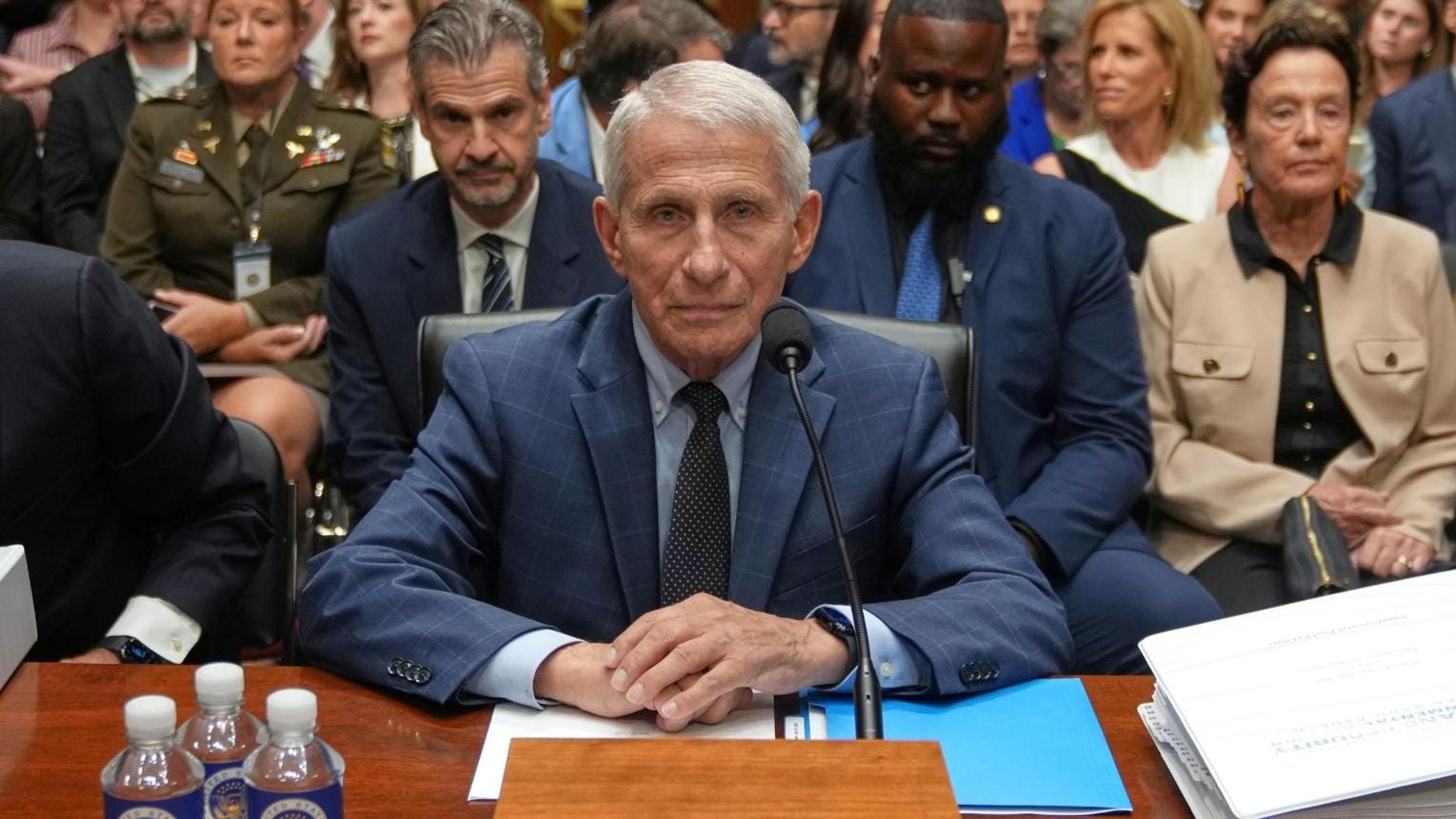
The contempt resolution is in. The phone copy may shine light on the factual claims Fauci declined to address.
By James Lyons-Weiler, PhD
August 6, 2026
The operative provision of the Senate contempt resolution is nine lines long. It directs the President of the Senate to certify a committee report describing Dr. Anthony Fauci’s refusal to answer pertinent questions and transmit it to the U.S. attorney for the District of Columbia, so that Fauci may be “proceeded against in the manner and form provided by law.”
On Thursday morning, the Senate Homeland Security and Governmental Affairs Committee approved that resolution by an 8–5 party-line vote. The vote followed Fauci’s July 29 appearance under subpoena, during which he invoked the Fifth Amendment 111 times rather than answer questions about COVID-19’s origins, risky life-sciences research, his prior congressional testimony and his conduct as a federal official. (Axios)
The night before the vote, the Wall Street Journal reported that the Department of Health and Human Services had transferred a copy of Fauci’s government iPhone to the Senate Permanent Subcommittee on Investigations, chaired by Senator Ron Johnson. (The Wall Street Journal)
The contempt vote and the phone transfer are related, but they are not the same kind of development. The resolution advances a legal claim: that Fauci could be compelled to answer and unlawfully refused. The phone copy introduces a new potential source of evidence: contemporaneous communications and records that may answer some of the questions Fauci would not.
The first claim will be disputed in court if the Department of Justice prosecutes. The second can be tested by examining the data.
What the Resolution Actually Says
The committee’s resolution identifies the inquiry as encompassing “risky life sciences research and the origins of the COVID-19 virus.” It records that the committee issued Fauci a subpoena on June 22, revised it on July 17 and required him to appear on July 29. The accompanying instructions sought testimony about COVID-19’s origins, risky research and Fauci’s tenure as a federal employee.
Fauci appeared and delivered prepared testimony addressing his government service, his prior testimony to Congress and records released during the investigation. He then announced that he would refuse to answer the committee’s questions under the Fifth Amendment.
The resolution next sets out Chairman Rand Paul’s legal findings.
Paul ruled that Fauci’s Fifth Amendment claim was unsupported for questions concerning conduct covered by the broad federal pardon issued to him on January 19, 2025. Paul also ruled that Fauci had waived any remaining privilege concerning subjects he voluntarily addressed in his opening statement. Paul directed Fauci to answer, warned that continued refusal could produce contempt proceedings, and recorded that Fauci continued to refuse.
Those are the findings supporting the resolution. They are not findings by a court. They are the committee majority’s statement of the case it wants the Justice Department to pursue.
The pardon is central to that case. According to the resolution, it covers federal offenses Fauci may have committed or participated in between January 1, 2014, and January 19, 2025, arising from his work as NIAID director, a member of the White House coronavirus organizations or chief medical adviser to the president.
Paul’s argument follows directly from that language: a witness ordinarily cannot invoke the privilege against self-incrimination when a valid pardon has eliminated the danger of federal prosecution for the conduct under examination.
Fauci’s answer is that the pardon may not eliminate every realistic source of criminal exposure. A presidential pardon does not prevent state prosecution. It does not cover conduct occurring after January 19, 2025. Nor would it necessarily protect a witness from exposure created by statements made during the 2026 proceeding itself. The legal dispute is therefore claim-specific. The relevant questions are what Fauci was asked, what conduct an answer could disclose, which sovereign could prosecute it and whether the danger was real rather than speculative. (Reuters)
The committee nevertheless faced more than a narrow invocation concerning a few carefully identified questions. Fauci declined to answer across the hearing. That prevented the committee from obtaining his account of the evidence while allowing his prepared statement to place his preferred account into the record.
Whether that combination constituted a waiver is one of the issues Paul has placed before DOJ.
The Committee Vote Does Not Complete the Process
The approved document is drafted as a resolution of the Senate. Its first page says Paul is reporting the resolution from committee for placement on the Senate calendar. It authorizes the President of the Senate—not the committee chairman—to certify the committee report.
That structure matters.
Under 2 U.S.C. § 192, criminal contempt may arise when a summoned witness willfully refuses to answer a pertinent question. Section 194 describes the certification of such a refusal to the appropriate U.S. attorney for presentation to a grand jury. The statutory text contemplates the failure being reported to the House or Senate and certification under the seal of the chamber.
The committee has approved the accusation and recommended the statutory response. It has not obtained approval from the full Senate.
Paul has indicated that he may send the committee materials directly to DOJ because advancing the resolution through the Senate would probably require 60 votes. Republicans currently lack that number. Reuters reports that the conventional process involves committee approval followed by approval of the full Senate, making Democratic support necessary. (Reuters)
DOJ can review whatever Paul submits. A congressional chairman may send evidence, legal arguments and requests for prosecution to federal prosecutors. Paul has done so previously concerning Fauci’s 2021 testimony. But a direct communication from Paul is not automatically equivalent to the certification described in the resolution and Section 194. (Homeland Security Committee)
DOJ also retains prosecutorial discretion. Its Office of Legal Counsel states that a U.S. attorney receiving a contempt citation retains the traditional authority to decline prosecution, including when the citation does not involve executive privilege. (Department of Justice)
The immediate legal posture is therefore clear enough. The committee has formally found that Fauci defied a valid order to answer pertinent questions. Paul can send that finding and the supporting record to DOJ immediately. Whether DOJ treats it as a completed statutory referral, opens an investigation, seeks a grand-jury presentation or declines to proceed remains unresolved.
The wording “the Senate held Fauci in contempt” overstates the institutional act. A Senate committee voted to hold him in contempt and approved a resolution designed for further Senate action.
That correction does not reduce the significance of the vote. It identifies what actually occurred.
The Phone Copy Changes the Evidentiary Question
The phone development should be described just as precisely.
HHS transferred a copy of Fauci’s iPhone to the Senate Homeland Security Permanent Subcommittee on Investigations. The available reporting does not establish that the physical phone itself is in Senate custody. It also does not establish the technical form of the copy. (The Wall Street Journal)
That missing detail determines the evidentiary value of the transfer.
A complete forensic image can preserve device databases, message content, attachments, timestamps, contact information, application records, file-system metadata and remnants of deleted material. A routine consumer backup, agency archive or selected export may contain only a fraction of those data.
The public record does not yet establish:
the dates covered by the copy;
whether the image is complete;
which applications were captured;
whether deleted information can be recovered;
whether communications stored in cloud or personal accounts are included;
whether the data have been authenticated; or
what chain-of-custody procedures HHS and the committee used.
Those facts should be disclosed before anyone claims that investigators have obtained the complete contents of Fauci’s pandemic-era phone.
The transfer is nevertheless important because the committee’s central claims concern knowledge, timing and consistency. Phone records may help establish what Fauci was told, what he communicated, whom he contacted and whether his private communications were consistent with his later public statements and congressional testimony.
That is not an assumption that the phone contains incriminating evidence. It is a statement of what the records could test.
Consider the specific propositions already under investigation:
Did Fauci privately treat a laboratory-associated origin as plausible while publicly presenting it as implausible or unsupported?
What role did Fauci play in communications among NIH officials, virologists, intelligence personnel and the authors of the Proximal Origin paper?
What did he know about federally funded coronavirus research conducted through EcoHealth Alliance and the Wuhan Institute of Virology?
Were his congressional descriptions of that research consistent with the grant documents, progress reports and internal communications available to him?
Did he direct government employees to delete federal records, and were the messages actually deleted from official systems?
Did his public account of contacts with intelligence agencies match the contemporaneous communications?
Each proposition requires different evidence. A diary entry may establish what Fauci recorded privately. An email may establish that a message was sent. A phone record may establish contact or timing. A grant document may establish the work funded. None should be substituted for the others.
Congressional Theory Moves Forward
Paul has created a public Reading Room intended to release primary documents, transcribed interviews and internal correspondence from the committee’s investigations. The archive is being expanded on a rolling basis. Recent releases include diary materials and other investigation records concerning COVID-19’s origins, federally funded research and Fauci’s contacts with national-security agencies. (Senator Rand Paul)
Those releases create an opportunity, but also a burden.
The committee cannot establish its case through captions, press-release summaries or selected pages alone. It should next publish enough surrounding material to permit independent review of chronology, authorship, meaning and context.
An instruction to delete an email is directly relevant to a claim about destruction or concealment of records. It does not establish that the email was deleted from every government system, that no archived copy remained or that Fauci acted with the criminal intent required for a particular offense. Those additional propositions require additional evidence. Paul has publicly alleged that newly obtained emails contradict Fauci’s prior testimony concerning deletion of official records; the underlying records, retention systems and complete publication determine whether that allegation is sustained. (Senator Rand Paul)
The same standard applies to Fauci.
A prepared statement does not answer a responsive question merely because it discusses the same general subject. A broad assertion that prior testimony was truthful does not resolve a specific contradiction between that testimony and a contemporaneous record. Invoking the Fifth prevents compelled self-incrimination, but it does not supply the public with an explanation of the evidence.
The committee should now publish a technical description of the phone copy, document its chain of custody and identify the search protocol used. Responsive records should be released in complete conversational context, subject to legitimate privacy, privilege and national-security protections. Exculpatory records should be published with the same care as records supporting the committee’s theory.
That is the evidentiary standard appropriate to an investigation of this importance.
What Has Now Been Established
The available record supports several findings.
Fauci appeared under subpoena, delivered prepared testimony and then repeatedly invoked the Fifth Amendment. Paul overruled the privilege for the reasons stated in the resolution and ordered Fauci to answer. Fauci continued to refuse. The committee subsequently voted 8–5 to approve a contempt resolution invoking 2 U.S.C. §§ 192 and 194.
Motion For Immunity From Prosecution in Exchange for Testimony Failed
Today, a motion to offer Fauci additional immunity from federal prosecution in exchange for complete testimony also failed. The proposal would have directly tested the stated reason for his silence: if potential federal prosecution justified invoking the Fifth Amendment, immunity could have removed that exposure and compelled responsive answers. Committee Republicans rejected the motion and instead approved the contempt resolution. The committee therefore chose to challenge Fauci’s invocation and seek possible prosecution for refusing to answer rather than provide new federal protection as the price of obtaining his testimony. The proposed immunity would not, however, have protected Fauci from possible state prosecution.
The committee vote did not itself complete the full-Senate certification process contemplated by its own resolution. Paul may nevertheless submit the committee’s findings and evidence directly to DOJ, which has discretion over any prosecution.
HHS also transferred a copy of Fauci’s government iPhone to Johnson’s investigative subcommittee. The technical completeness and contents of that copy have not been disclosed publicly. (The Wall Street Journal)
I do not claim that Fauci’s invocation of the Fifth proves the underlying allegations. I do claim that his refusal left material questions unanswered after the committee presented him with records it regards as inconsistent with his prior account.
I do not claim that the phone copy contains incriminating evidence. Its acquisition means the existence, completeness and relevance of such evidence are now matters capable of direct examination rather than speculation.
The next stage should therefore be judged by the quality of the documentary audit. Congress should establish exactly what HHS transferred, preserve the original data, authenticate responsive records and compare them claim by claim against Fauci’s testimony, diary entries, emails, funding records and public statements.
Fauci chose not to provide oral answers to the committee’s questions. Congress now possesses records that may provide documentary answers.
Whether they do is no longer a matter of rhetoric. It is a matter of evidence.
Did you consult with Steve Kirsch on this? I will curse at this point. The two of you are the fuckin' smartest guys in the room. I am glad we have you. Not sure how a PhD with biomedical roots has so much understanding of governement and law. But. I'll take it.
My focus, as you know has alway been Phrma prosecution via tort claims, but the Fauci affair will really galvanize the public, since everyone has had a searing Covid experience. Even if half ( the surviving, not harmed) the population is partisan politics blind.
Nail the SOB.
This deplorable goon has contempt for the entire human race, not just Congress! He even has contempt for beagles...