



We were once told the corruption in medicine is too deep, too moneyed, too entrenched to touch. That the incentives are load-bearing. That the agencies are captured beyond repair, the journals bought, the guidelines written by the same hands that profit from them. We were told to be realistic, which in practice means: sit down.
That was 2015, and after a decade of sustained effort, we have HHS and have vaccine makers scrambling to update their products for safety.
Where will medicine be in 2035? That, my friends, is up to us and it depends on whether we have the smarts and the will the induce revolutionary reform across the board.
We have identified 22 ways society can act through legislation to de-corrupt medicine. Each one matters. We need to learn those ideas, debate them, consider new insights and bring the refined versions to legislators at the state and federal level.
It’s not just vaccines. But vaccines are there, too.
A single idea that came out of the work planning this course is already a draft bill, with a legislative sponsor, in the state of Michigan. Not a petition. Not a white paper destined for a drawer. A bill — the kind of document that, if it passes, changes what is legal for doctors to do, or not do, and what is not.
That is what I mean when I say reform was supposed to be impossible. The impossibility was a story, and the story just lost a data point.
The diagnosis has to be structural, or it is useless
For years the reform conversation has run on outrage. Outrage is honest, and it is exhausting, and by itself it changes nothing — because outrage has no target. You cannot legislate against a feeling.
The corruption in modern medicine is not, at bottom, a collection of bad people. If it were, it would be a solvable personnel problem. It is a structure — a set of laws, rules, and incentives that make the corrupt outcome the rational one for otherwise ordinary actors. Consider a partial map of the machinery:
Claims integrity and federal fraud law — what a manufacturer or provider is allowed to say, and what happens when the claim is false.
PBMs, rebates, and clinical compensation — the money that decides which drug reaches which patient, and why.
Trial registration, full data access, and correction due process — whether the evidence base can be audited at all, and whether a wrong result can ever be set right.
FDA independence, surrogate endpoints, and postmarket accountability — whether a product is judged on whether it helps people or on whether a number moved.
Iatrogenic harm and treatment-cascade responsibility — who is accountable when the treatment, not the disease, does the damage.
Patient data and automated-denial rights — whether an algorithm can refuse your care with no one answerable for the refusal.
Hospitals, medical boards, antitrust, and whistleblower protection — whether the people who see the problem from the inside can speak without being destroyed for it.
Every one of these is a place where a law exists, or fails to exist, or exists in a form written to protect the wrong party. That is the good news hiding inside the bad news. A structure held in place by statute can be changed by statute. You do not have to convert every bad actor. You have to change the rules they operate under.
A reform is a hypothesis. So we treat it like one.
Here is where we differ from a great deal of well-meaning advocacy, and where the Popperian in me refuses to be quiet.
A proposed law is a hypothesis: if we enact this, the corrupt outcome becomes harder and the honest outcome becomes easier. Like any hypothesis, it is only worth anything if it can survive attack. A model act that has never faced a constitutional objection, a fiscal objection, a scientific objection, or an operational objection is not a reform. It is a wish with legal formatting.
So the standard has to be adversarial. The reform must be dragged in front of every serious challenge before it ever reaches a sponsor: Is it constitutional? What does it cost, and who pays? Does it survive contact with the actual evidence? Can it be administered, or does it die on the first day of implementation? A proposal that walks out the far side of that hearing still standing is a proposal worth a legislator’s name.
That is the discipline. Not louder complaints — better bills.
The generation this is aimed at
I am going to speak plainly to the people who have been in this for decades.
You watched the drift. You remember when the incentives were different, when the correction mechanisms still had teeth, when “the science” was an argument and not an order. You carry the institutional memory that the capture depends on the public not having. You have professional standing, or the scars of having lost it for telling the truth. You know where the levers are because you have spent a working lifetime standing next to them.
That knowledge is not nostalgia. Right now it is one of the most valuable strategic assets in the country, and it is being wasted every day it sits unused. The reform movement does not need you as an audience. It needs you as a drafter.
Let’s give every doctor every incentive to become ethical physicians.
There is a duty in that, and I am not embarrassed to name it. You served once — in your home, in a lab, a clinic, a courtroom, a classroom, a community. The call has come around again, and this time the deliverable is law.
Where the work happens
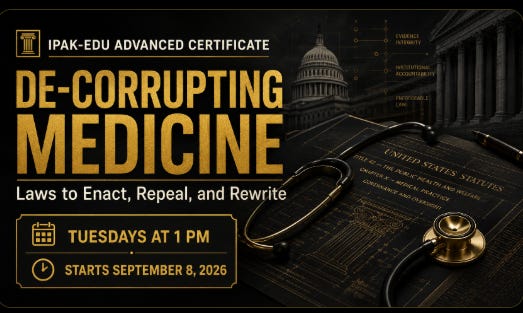
De-Corrupting Medicine: Laws to Enact, Repeal, and Rewrite is an IPAK-EDU Advanced Certificate series, and it is built as a live, interactive working laboratory rather than a seminar. Each session runs the same disciplined cycle: map the authority, audit the record, trace the mechanism, then design and stress-test the remedy. It moves through the machinery above and ends in a legislative drafting laboratory and an adversarial hearing, where your proposed law faces constitutional, fiscal, scientific, and operational challenge before it earns the word finished.
The capstone is a complete model act — with section-by-section analysis, a constitutional and administrative-law memorandum, a fiscal and implementation note, a loophole analysis, and a revision record. No law degree is required. You need only be able to read primary legal and scientific sources and tell evidence from allegation.
Two things make this different from anything I have taught before.
The first: your ideas will not sit in a notebook. The strongest proposals from the cohort will be platformed, refined, drafted, and carried toward legislators — the same path the Michigan bill already traveled. This is a room where good work goes somewhere.
The second: it is live, twice each week, at times chosen to work for the people in it. A cohort, not a recording. We build together, in real time, toward a single audacious target — a miracle legislative session, where a stack of well-built, hearing-tested bills lands on desks at once and dares to be ignored.
It is up to us
This series will not proceed unless enough people engage. Therefore, this is literally your call to duty. Do not assume someone else with show up.
We also do not have the luxury of pessimism. The people who benefit from the current structure are counting on your belief that it cannot be changed. That belief is now demonstrably false, and we already have a bill with a sponsor to prove it.
Make the laboratory happens with a seat with your name on it.
Bring the idea you have been carrying for years. Let us find out, together and out loud, whether it can survive the hearing.
The work is ours. It has always been ours. Let us go do it.
— James Lyons-Weiler, PhD
30% off this series for ipakedu.online. Use the four easy payments option.
MEMBERS OF IPAKEDU.ONLINE ENJOY 30% OFF ALL COURSES, WEBINARS AND SERIES
This is such a noble effort. I want to say nothing to discourage, but to pray it can be done.
How did the US descend into this morass of fussy bullying? I guess smart people lapsed in eternal vigilence!