


By James Lyons-Weiler, PhD
Somewhere along the way, most of us absorbed a quiet lie: that the season for learning something purely because it fascinates you has passed. School was for the young. The career years were for producing. And whatever curiosity you carried about how life actually works — the machinery inside a single cell, the logic of the immune system, why cancer happens, how your body reads its own genome — got filed under someday.
I would like to make someday this term.
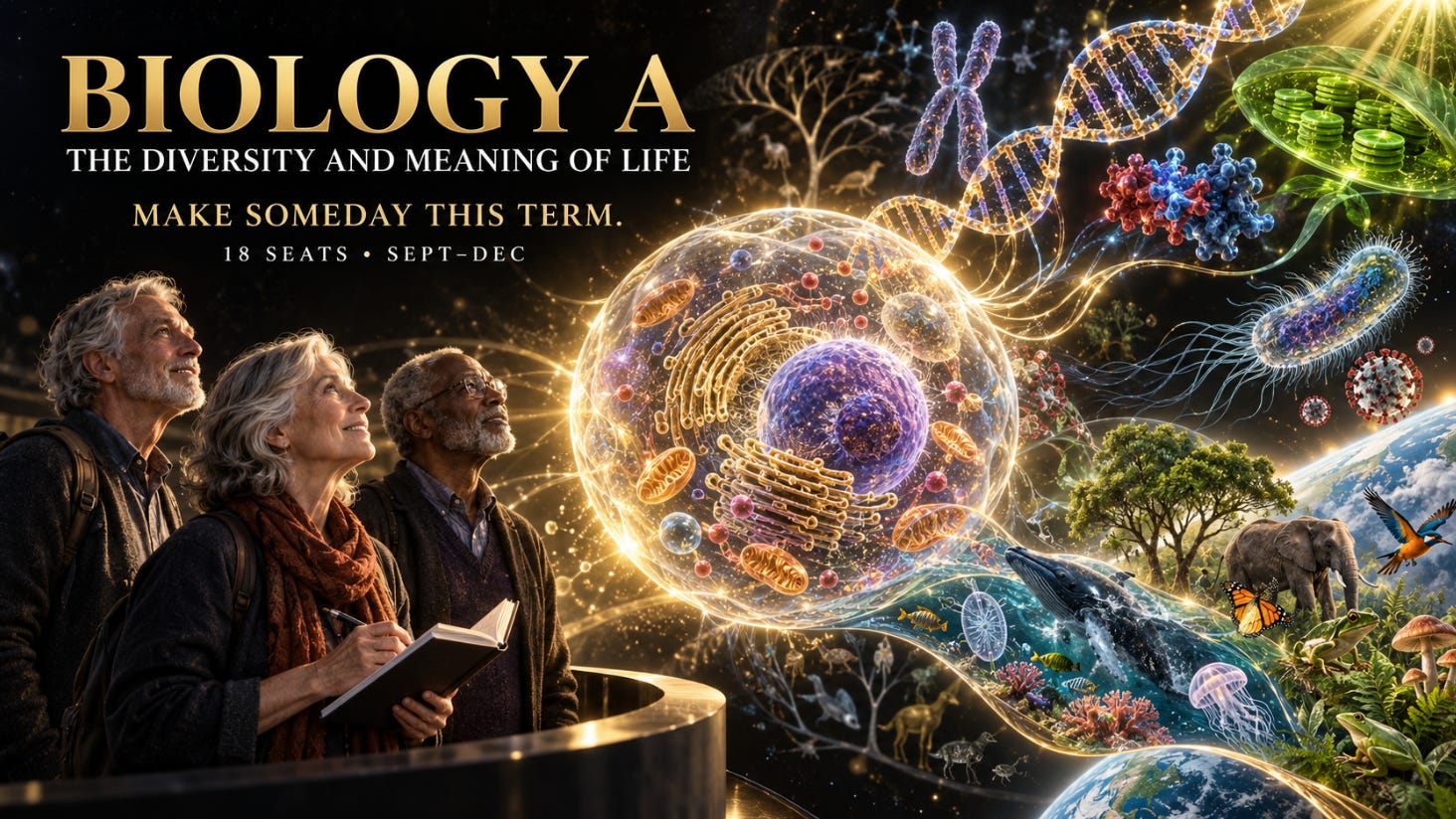
I am opening two courses, Biology A (Sept-Dec) and Biology B (Jan-June), and I am looking for eighteen people. Not eighteen hundred. Eighteen. People who have wanted, sometimes for decades, to learn biology seriously and from the ground up — for no reason other than that they want to understand themselves, and the living world they are a part of, before the chance slips by.
You are not too late. The evidence points the other way.
There is a stubborn myth that the aging brain is a closing door. The research on cognitive aging tells a more interesting and more hopeful story — with one important condition attached.
The organizing idea is cognitive reserve: the brain’s capacity to keep functioning well despite the wear of age, built up over a lifetime of mental engagement. Yaakov Stern’s synthesis of this literature is the standard reference, and it reframes decline not as a fixed schedule but as something reserve can push back against.¹
The condition is this: it has to be real learning. In the Synapse Project, Denise Park and colleagues randomized older adults either to genuinely demanding new skills — the kind that make you struggle — or to more passive, comfortable activities. Only the people who took on something hard showed improved memory function. Comfort did not do it. Difficulty did.² Grappling with immunology or the logic of a genome is precisely the kind of productive difficulty that study points to. Bio-B breaks rank with University courses by offering you an overview in immunology - in addition to the standard fare.
Across the long arc of a life, people who stay cognitively active tend to decline more slowly late in life, and the Rush group’s work suggests this holds even after accounting for the physical burden of disease in the brain.³ And in the largest recent accounting of what actually moves the needle on dementia risk, the Lancet Commission placed less education and social isolation among the modifiable factors — a substantial share of risk that is not written in our genes.⁴
I want to be honest with you the way I would want a scientist to be honest with me, because that habit of mind is half of what these courses are about. Much of this evidence is observational, and observational data can mislead: people who are already declining often withdraw from demanding activity, which can make engagement look more protective than it is. That caveat is real. But the strongest claims here rest on randomized trials, not just correlation — and even the cautious reading lands in the same place. Learning hard things, in the company of others, is one of the few interventions for the aging mind that has genuine evidence behind it, no prescription, and no side effects worth the name.
You would be doing something good for your brain by enrolling. But that is the smaller reason. The larger one is that it is worth understanding how you work.
What we will actually study together
Biology A and Biology B are the foundation — the real thing, not a watered-down “science for seniors.” We build from the cell and the molecule upward, to organismal biology and human health - so that the rest of the living world becomes legible to you. We’ll also discuss weekly updates on latest finding in Biology!
And that foundation is a door. Once you have it, the courses that follow open up to you in later terms: genetics, immunology, autoimmunity, environmental toxicology, and the biology of cancer — studied with me, in the same community, with the same commitment to reading the evidence honestly and refusing to be told what to think.
This is the part that matters at our age especially. When you understand the immune system, an autoimmune diagnosis in the family stops being a black box. When you understand toxicology, the daily noise about what is and isn’t harming you sorts itself into signal and marketing. When you understand cancer at the level of the cell, you can sit in a consultation room and actually follow the conversation — and ask the question that changes it. This is not knowledge for a shelf. It is knowledge for your own life.
Why community is not a garnish
Learning this material alone is possible and lonely. Learning it together is something else entirely — the questions one person asks unlock the room, the person who was a nurse or an engineer or a farmer brings a lens no textbook has, and the material sticks because you argued about it with people you have come to know.
There is a reason I keep pointing at the isolation finding above. The same social connection that the evidence links to a healthier aging mind is the thing a real cohort provides on its own. A standing group of serious, curious peers, meeting around ideas that matter — that is a rare thing to find after the career years and the child-raising years are behind you. Purpose and belonging are not soft extras here; the work on purpose in life links a strong sense of it to meaningfully lower risk of cognitive decline.⁵ A cohort gives you both, as a byproduct of doing something genuinely worthwhile.
Eighteen is not an arbitrary number. It is small enough that we will know each other’s names and thinking, and large enough that the conversation has real range. It is the size of a community, not an audience.
The kind of people we are hoping to find
Not a specialist. Not necessarily someone with a background in science (although during the first run of the course we had two people with PhDs in physics!). We want people are willing to be a beginner at a certain age with their dignity fully intact — because there is nothing more dignified than that.
Someone who would rather understand one thing truly than be handed ten conclusions to accept. Someone who is comfortable saying “I never knew that”, which is the only sentence that has ever moved science forward. Someone who has carried this particular curiosity a long way and is ready, finally, to set it down and actually learn.
If you have always wanted to understand biology — for your own sake, for the plain wonder of it, and for the person you will be with that understanding in hand — then I am looking for you.
There are eighteen seats. I would be glad if one of them were yours.
[ To reserve a place in the Biology A / Biology B cohort, join ipakedu.online and find it here]
References
Stern Y. Cognitive reserve in ageing and Alzheimer’s disease. Lancet Neurology. 2012;11(11):1006–1012.
Park DC, Lodi-Smith J, Drew L, et al. The impact of sustained engagement on cognitive function in older adults: the Synapse Project. Psychological Science. 2014;25(1):103–112.
Wilson RS, Boyle PA, Yu L, et al. Life-span cognitive activity, neuropathologic burden, and cognitive aging. Neurology. 2013;81(4):314–321.
Livingston G, Huntley J, Sommerlad A, et al. Dementia prevention, intervention, and care: 2020 report of the Lancet Commission. Lancet. 2020;396(10248):413–446.
Boyle PA, Buchman AS, Barnes LL, Bennett DA. Effect of a purpose in life on risk of incident Alzheimer disease and mild cognitive impairment in community-dwelling older persons. Archives of General Psychiatry. 2010;67(3):304–310.
Education that is truly scientific and not politically connected is one of the most important things humanity needs in order to prevent more pLandemics from happening. Granted, there were millions of highly educated people in biology and medicine who allowed themselves to be hypnotized into going against their knowledge and training, but if more people had had a solid background in biology, and an understanding of how science is often manipulated, then those of us who did not succumb to the lies about the "vaccine" would have had a much stronger position in which to resist! I salute you, James, for creating this program!
I already have a very strong biology background, so I would not want to take one of the 18 seats away from someone else, but I would love to be able to watch from a distance to see the material being taught!
I salute you, James, for making a difference in the world by making this offering! God bless you!
What school would you say your you are coming from Epicurean,, Stoic, Galenic?